Organic vs. outlining

There are an infinite number of ways to be inspired, but when it comes to putting your story down, you’ll have to choose between two approaches.

The first is the organic approach. That’s where you just write. Ideas, characters and story unfold with each keystroke. If you’ve ever had to improvise an all-new story for an insomniac child, where you surprise yourself with every new plot twist that comes out of your brain without you even knowing it was there… it’s like that. Only, you’re the one asking, what happens next? Continuity, character development, setting and so much more can be added and finessed in the next draft(s). (Spoiler: there will be many drafts). You can think of this as the riffing stage. You’re just picking up your guitar and noodling around, letting licks and riffs and chord progressions fall out any which way while you record it. This is strictly inspiration only. And it’s kind of awesome.

Doof Warrior

Any excuse to use this photo again. Hypothesis: the Doof Warrior does not outline

Working on pure impulse is fun. It’s almost meditative, a trance state. But it leaves a lot of the hard work for the drafts that follow. It’s like making dinner with whatever you grab from the fridge — you’ll have to clean up all those tubs and plates afterward. Same with writing — you grab any ideas that come your way, and it feels great. Just be aware that later, you’ll be in front of your metaphorical kitchen sink for a long time scrubbing.

(Quick sidebar: your first draft will always be a messy, unwieldy beast. You’ll probably hate it. But think of it this way: your first draft is PERFECT! Yes, we said it. Perfect. Why? Because it contains everything you need, and a lot more besides. You’ll be surprised just how many future narrative problems will be solved by seemingly random things from that out of control first draft. This is why you should never, ever censor your first draft.)

If the dread of that massive cleanup prevents you from enjoying the meal, then rejoice, for there is another way: the outlining approach might just be the best thing for you. This involves creating an outline of your entire story. You’ll work out your characters’ arcs in advance, then determine what story beats you’ll need to further those arcs. You’ll break out what your acts are (e.g. three acts for a movie or novel, 5 or 6 for a network TV script), and how your character development and action flows through them. This is the blueprint of your story. The “what happens next” of it, which is often what prompts hours of looking out the window instead of at your screen. With an outline, you have what happens next. When you go to start actually writing the story, you’ll get into the “how it happens” phase.
Outline notes

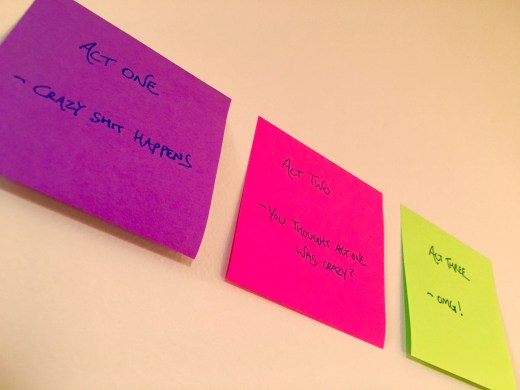
We’re patenting this story structure

Creating an outline, whether in a notebook, on post-it notes, index cards or flip charts, can save so much time when writing and editing. (If you don’t outline, and use your first draft to work out what your story needs to be, you’ll potentially have a lot more heavy-duty rewriting and restructuring to do in draft two). It can also help inspire your story as you write. We’ll be honest, it’s not the most fun part of writing. Like making a film or recording a song, the prep work is important and saves you time and energy in the end… but it is work.

So, what does outlining look like?

In its simplest form, it’s you working out and writing down ahead of time who your characters are, and what happens to them. A good place to start is with your main character(s) — who are they, and at a high level, what is their arc? Are they good, and going bad? Vice versa? Are they discovering something about themselves that changes their lives forever? Where will they be at the end, and how is that different from the start? Once you know who you’re writing about, and the basic emotional/psychological journey you want them to take, you can think about what needs to happen to get them there. This is focusing on character first, and using that to determine plot. As you do this, your other characters can come into play — who will help your protagonist, and who will get in their way? Who is their nemesis, their enemy? What are all of their arcs? Because all your characters should have some kind of arc or journey that they’re on. This keeps them from becoming cardboard cutouts that you’re just moving around for the sake of the plot.

It doesn’t take much to give your characters depth and nuance. Look at Sergeant Al Powell in Die Hard (which is possibly the most perfectly constructed piece of pop culture of all time — all the writing lessons you’ll ever need are in that movie). Al joins the action in Act Two. He could have just been a random cop without much going on other than being a device to ask John McClane questions to help keep the audience in the loop. But he’s so much more than that. It starts with his intro: he’s in a gas station buying twinkies when he gets the call to go to Nakatomi Plaza. That detail on its own is something, but it wouldn’t have been enough — but we get the spin — they’re for his pregnant wife, which adds a layer of “we don’t want anything to happen to him!” and also allows for a brief joke with the guy behind the till. That scene is at its core “cop gets the call,” but now it’s full of little details and dimensions that help give his character a little something more (and give the actor something to play).
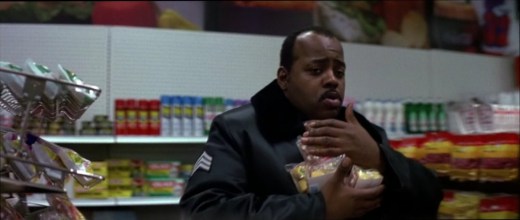
Al Powell and Twinkies

Al. And the Twinkies.

This continues for him throughout the movie — and it’s not just adding random details either — each piece of his story means something to the movie, and to his arc, and to McClane’s arc. Your homework is to watch Die Hard and analyze how they make Al relatable, accessible, interesting, and, with his backstory and arc, utterly necessary for the movie to succeed.  Then think about how you can do this for your “minor” characters — because really, none of them are truly minor. If they are in your story, they’d better have a good reason to be there.

Al Powell Cop Car

From Twinkies to ringside seat at Nakatomi Plaza: character development very much pictured

Once you have your main character and their arc, and some of your other characters, fleshed out, and you’ve worked out what your basic story could be, then you can drill down to the next layer of outlining: breaking that story down into more manageable units. It’s helpful to think of your story in acts, whether it’s a movie in three acts, or a TV show in five or six. You can start deciding which pieces of story might go in which act. The ends of your acts will need to push the audience dramatically into the next act, whatever kind of story you’re writing. Once you have that, you can drill down again, to the level of sequences (composed of scenes), and individual scenes. For a novel, you can do this, and also be thinking about chapters too. Where will your major story points occur? Where (and how) will you reveal information to your readers/audience? You can chart this in many different ways — whatever works for you is what you need to do. As you start seeing how you scenes and beats can be laid out across your story, more of the story will come to you.

That may all sound too clinical or analytical, but just because outlining like this involves a lot of discipline doesn’t mean that it has to diminish your artistic flow. Outlining is the halfway house between the riffing stage, and the engineering stage that is editing. You’re still improvising as you lock down your story’s structure, you’re still feeling out those characters, and thinking of cool shit for them to do… it’s just a more organized kind of riffing. And once that outline is locked down, you can just dive into the writing and not be held back by not knowing where your plot needs to go — you can make that first draft really sing and get inspired.

And remember, there’s always discovery. You always have to be open to the cool idea, the new direction. The outline is there to make the process easier — but it’s not necessarily set in stone. You may find that your story needs to go in a different direction, and that’s OK. You can just update the outline, and keep on trucking.

Different approaches work for different writers, sometimes on different projects. What worked for your novel may not work for your screenplay. The key thing is that you find the process that works for you. The way of writing that gets you to the promised land of actually finishing what you started.

And that’s the ultimate goal: whatever your story is, you thought of it, which means that you can finish it. Your creativity isn’t that cruel — if your muse delivers a beautiful idea to you… trust her. She wouldn’t send it your way if you weren’t capable of executing it (the idea, not the muse!).

Do what’s right for you as a writer. And see it through. Don’t exist in a dense forest thicketed with unfinished projects. Make your writing life clear and open by turning those beautiful ideas into beautiful realities. It feels good.

Things We Like: Illuminae (The Illuminae Files 01) by Amie Kaufman & Jay Kristoff

Every so often, a book comes along that makes you want to retroactively drop the ratings of pretty much all your books on Goodreads by a star, because now you know what five stars really looks like (pretty much all; not actually all… *cough* JK Rowling and Patrick Ness and Laini Taylor are exempt *cough*).

ILLUMINAE is that book.

Illuminae Ray V6FrontOnlyA2A_V3.indd

It’s a five star book. Really, it’s six stars. All the stars, in fact, and appropriately enough, because this is, simply put, a rollicking, gripping, adrenalin-rushing, heartrending and emotionally bad-ass space novel. It’s YA sci-fi, in space, and then some. No spoilers here, but the novel opens with an attack on a remote mining outpost, deep in space. The occupants scramble to escape as space fights erupt in the skies above.

Space fights, people. Space fights.

The survivors make their escape on three different spacecraft, but the attackers won’t give up so easy. The rest of the novel unfolds from there in a relentless and thrilling story that Never. Lets. Up. It keeps evolving, spinning, reversing, tricking you, lulling you, surprising you, breaking your heart, and you JUST CANNOT PUT IT DOWN.

Seriously, when a book contains awesome space stuff and what scientists are describing as ALL THE FEELS, how can you be expected to live your life and go about your normal business?! You can’t — you can only keep reading as the authors build and build their tension to unbearable levels… and then keep building it some more.

And then some more.

Essentially, this book checks every box you could think of, and plenty that you would never imagine. It goes way beyond what you’d expect: it has pictures, diagrams, beautifully creative layout and typography. Its form often reflects its content in a poetic, mesmerizing way; it’s endlessly creative in the way it presents its story. And it’s not a gimmick that it does this, or that it’s composed of emails, surveillance reports, IM chat transcriptions, etc — it’s entirely necessary, and with a story as unstoppable as this one,  you barely notice that this isn’t a traditional narrative.

ILLUMINAE is something we’ve never seen before, and Amie Kaufman and Jay Kristoff need all the praise for that. They are amazing writers who know how to tell stunning, emotional and epic stories. They’ve made something extraordinary here.

Here are some awards that this book wins:

  1. Best space scenes in YA sci-fi (intergalactic travel, awesome spaceships, insane battles, the majesty of the universe, etc)
  2. Best use of nonstop, brutal sarcasm in stressful situations
  3. Most thrilling novel of 2015
  4. Coolest novel of 2015
  5. Most “when you’ve finished, turn back to page 1 and read it again” novel of 2015
  6. Best Artificial Intelligence in popular culture since HAL in 2001 (that NEEDS to be voiced by David Tennant in the Brad Pitt-poduced movie adaption)(seriously, Brad Pitt is producing the movie adaptation)
  7. Best Brad Pitt movie adaption of all time (to be awarded at some point in the future)

Rating: 

Six out of five space battles

Rewriting your short film script

When you first start writing your script, you should censor… nothing! Let the ideas flow, let the characters do something crazy. Think big, dream big… all that good stuff.

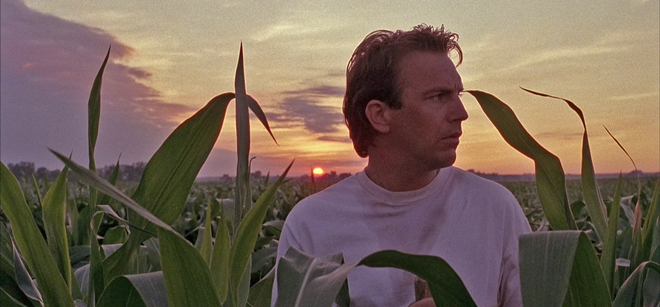
You need to get all Field Of Dreams up in here... if you build it...

You need to get all Field Of Dreams up in here…

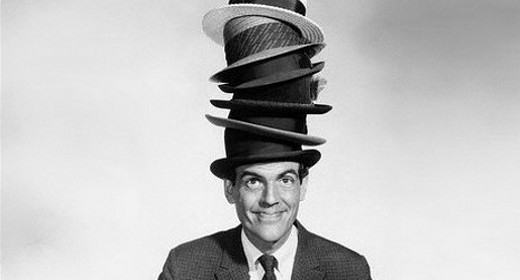
When you’ve finished that first draft though, you’re going to need to switch out of writer mode and put on a different hat.

Spoiler: there's more than one hat

Spoiler: there’s more than one hat

Several hats, actually. The first is your editor hat. With any type of writing, you need to go over your work and approach it with unnerving, surgical precision, cutting away and removing things that you couldn’t possibly imagine losing but that the piece will be much better without.

You, editing

You, editing

It’s often brutal, always necessary. If something is slowing your story down, making it too long, or is tonally off — snip snip! Once you have a tight script, in which every word is weighted with pivotal importance, it’s time for a wardrobe change as you look for your set designer hat.

This is where you have to evaluate your script on the basis of what the director (spoiler: this is you just with a different hat) can actually, practically shoot. This means dealing with the reality of your situation. If you set your script in a cafe, or a store, or an airplane, do you actually have the ability to (a) shoot in a real cafe, store, or airplane, or (b) recreate the interiors you need using creative set design (see our previous post)?

Shooting in a real location, such as a cafe or store, involves getting permission from the owner and working out all the details with them. Most will only let you film after hours for a set period of time, and they may insist their employees are present to keep an eye on things… which could be costly. They may let you use the location but not their materials — meaning you’ll have to bring in your own props (mugs, coffee machine, etc.). Along with props, you’ll need to bring in lighting and, if the script calls for them, extras. There are a lot of logistics involved with real locations, and depending what your relationship is with the owner, there could be insurance issues involved as well.

But don’t let this deter you!

The golden rule of making short films is that it NEVER hurts to ask. Just be polite and make sure they are comfortable with every aspect of your set and production. Don’t paint a wall or move a table without clearing it with the owner first.

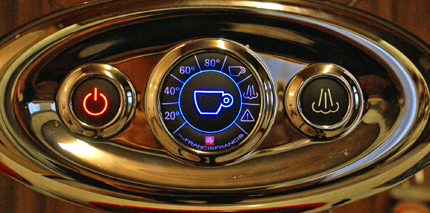
If you do manage to make a deal and secure a real location, and get the limitations worked out, you’ll have to put your director hat back on (retroactive spoiler: you were wearing your producer hat in the last couple of paragraphs) and work out your shot list. That’s basically a list of all the places you want to point your camera — we’ll cover that in a later post.  A shot list will help you as the set designer figure out what will be in the scene. If it’s not exactly as the script described — you can’t have your lead character cleaning out the uber-expensive espresso machine because part of the deal with the owner was no touching anything that cost more that the coffee you were buying the cast and the crew — then you’ll have to change your script.

Sometimes it’s as simple as a tweak to an action sequence (e.g. instead of running across rooftops, your chase takes place on the street), but if that espresso machine represented all your character’s hopes and dreams of one day moving to Italy (and your short was a beautiful yet melancholic ode to the poetic symbolism of said machine, which actually sounds kind of cool!), you’re going to have some serious rewriting to do.

It's so pretty...

It’s so pretty…

Being unable to get a location you were hoping for, like getting turned down by American Airlines to make your movie on a 747, doesn’t mean you have to toss your script out the window. First, that’s littering and we would never encourage that, and second, it’s all part of the process, baby. With your set designer hat back on, you’re going to have to look around at what you can do. Is it possible to recreate the interior of an airplane? How about just the tiny space where the flight attendants hang out as they load the drink cart and talk about that rude bastard in row 23. All you need is a cart and a ridiculously small room.

If your original script had a flight attendant who’s scared of heights walking down the aisle, dealing with one flyer after another as she/he rolls past the rows, you’ll have to put your writing hat back on and change the dynamics without losing the tone, or the essential point of your story (it’s surprising how well the point of your story can survive intact through huge rewrites). Having the flyers approach the attendant as they load the cart instead could be a quick solution, but if it’s not as funny, or seems too contrived, you’ll have to dramatically change the scene, and possibly even aspects of the characters. If you changed the setting to a bank, for example, where customers are more likely to approach a teller, your bank teller being afraid of heights wouldn’t be so impactful, and any callbacks to that fact would have to be removed from the script: anytime you make changes, it’s a ripple effect.

Any excuse to reference Jurassic Park...

Any excuse to reference Jurassic Park…

This is the messy art of rewriting.

Seriously, it's messy

Seriously, it’s messy

Sometimes you might need to lose the scene altogether. In that case, you’ll have to make sure the important information in any cut scene is dispersed throughout the rest of the script. Keep in mind that you may also need to adjust the scenes before and after the cut scene, so that your story still flows (ripple!). And watch out for any callbacks to that lost scene. If you edit out a set-up, you need to take out the payoff too. You might even need to create a new scene to replace the one you lost. If you can reuse a set that is already booked or built, all the better for the set designer (which is still you, by the way).

As a writer, it can be extremely soul-crushing to have to change your vision to cater to the pain-in-the-butt reality of the situation (#writerslife). But don’t give up. Ever. Try to be open to all the possibilities. You might have written a REALLY cool fight sequence in a train station, but thanks to ‘security concerns’ you weren’t allowed to film it. Exchanging that scene for one in which your character stumbles out of the station doorway, covered in blood, clothes torn up, could be all the action you need. Add a few words to another character about the fight and you’ve taken a logistically challenging three minute scene and turned it into a 30 second scene that was simple to shoot. Nothing of the plot was lost, and your film is now tighter.

Short films: the art of the shortcut.

Setting isn’t your only potential obstacle though. If you’ve written a key part for a 6’4″ lady with extreme martial arts skills and the ability to trapeze (because, you know, your short is called Circus Ninja 3)… kudos for the creativity, but get ready to rewrite the part if you can’t find an actress with the physical look and skill set to do that. Gwendoline Christie just might not be available, sorry! Depending on your pool of available actors, you may not be able to find someone to fit that role, so you grab your casting director hat. It fits snugly over your writer’s hat, don’t worry.

As casting director, you have to remember that it’s far more important to get the best actors you can to really make your lines sing. As a writer, you’ll need to zero in on what is important about your character, and find an actor who can work with those aspects and make them their own.

Rewriting your short film can seem overwhelming, especially when you started out with an in-air action movie about a vertiginous flight attendant and her extremely tall arch-enemy who works at the circus… and it then becomes about a bank teller fighting a spirited average-height nemesis who studied judo for a few months. Your new version will still have a comedy and truth all its own; all your own. The key thing to remember throughout the rewriting process is that operating with restrictions can spark your creativity even more (there’s a reason you could write a 5000 word term paper the night before it was due), whether it’s with set design, casting, or shooting.

Embrace these moments as you work towards making and finishing your short as opportunities to make your script even better.

Winning the Comcast/NBCUniversal TV Prime Time Award

Writing can be a lonely process, even when you’re writing as a team.

For the majority of the time, you write with absolutely no knowledge at all of whether people will ever respond to your writing. You’re writing in the dark. That’s the job; we signed up for it, it’s part of the crazy wonderful life of being a writer. That said, it’s always nice when, every now and then, someone shines a light on the writing that you’re doing. We look up, blinking, slightly taken aback that someone likes what we’re doing. It’s a funny life — you have to believe in what you’re doing 100% with ironclad certitude — you couldn’t possibly make it through the rejections and knockbacks if you didn’t — and yet when someone actually says, this is good, there’s always that feeling of surprise. Like… really? Us?

Awards

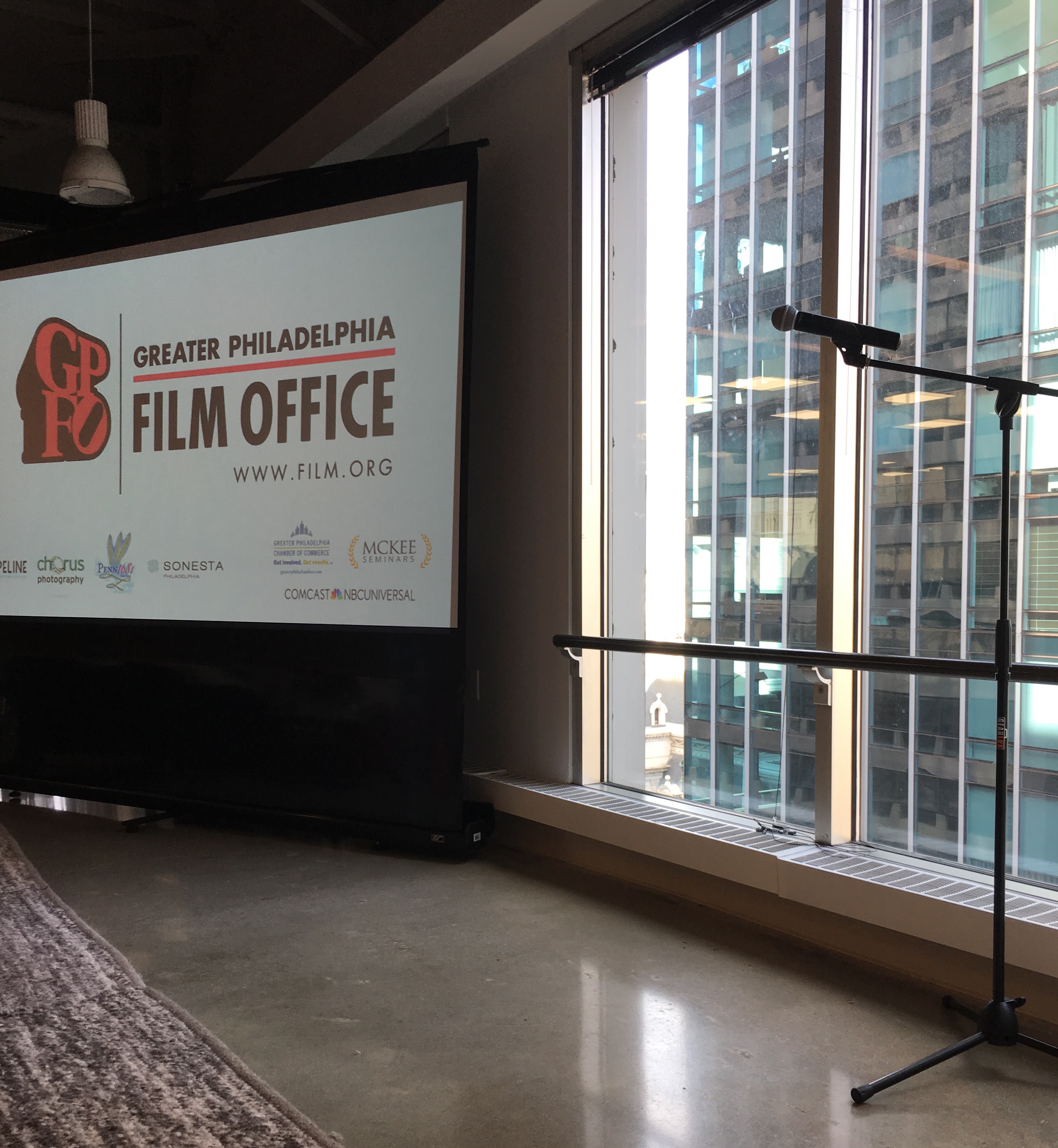
So, when our TV pilot script USE OF FORCE was one of three finalists for the Greater Philadelphia Film Office SIP Screenwriting TV awards, we were shocked. When our script won, officially the Comcast/NBCUniversal TV Prime Time award, we were stunned and overjoyed! That recognition and validation meant so much. It was a particularly nice kind of light to have shone on your work.

Plus, writers don’t get out much. So getting to attend an award ceremony in a beautifully designed space in Center City (with a great view), talk to some awesome people, and eat some fine food… yeah, that was nice!

View

So we’re grateful on many counts — we really appreciate all the people who helped get us there — the readers, the GPFO (special shout-out to Joan!), and the judges. A heartfelt thank you to all who believed in us.

Here’s the official press release.

The cold never bothered us anyway…

Now that CORRUPTED has hit the virtual shelves, we’re getting ready to gear up for book three. It’s definitely a busy time here at Croucher Towers. We’re finishing up a rewrite of the movie script we wrote last year, which placed quite well in a few competitions. We got some great feedback and notes on it, which gave us some good stuff to think about and work on… so we dived right back in to really pull it apart and put it back together again. Although the central character through line is unchanged, each of the three acts has been heavily restructured, some substantial new scenes added, and we’ve cut out a LOT of what was there before. Editing is ruthlessness. You have be cold, like Elsa. (Or Captain Cold in The Flash). There’s no room for sentimentality or “but I love that scene”. The story becomes your master and you have to obey (but not in a 50 shades kind of way). It’s a thrilling process as you clear away the lines and scenes that you realize are slowing things down, and the script takes its final, streamlined shape.

Once that’s done, the final planning for and writing of book three will begin in earnest, as we take all the ideas we’ve been developing for our characters’ arcs and work out where to add robots and aliens. WE LOVE WRITING!!! 🙂

Back to the index cards and flip charts and laptops and iPads and iPhone notes!

We Bought A Zoo: Writing, zebras, and asking “why not?”

We Bought A Zoo is such a Cameron Crowe movie, in the most awesome of ways.

Quirky, self-aware yet beautiful dialogue? Check. Heartwarming scenes that stumble over themselves to move you (and always succeed)? Check. Naturalistic, charming performances? You know it. Eddie Vedder and Bob Dylan on a (killer) soundtrack? Of course. Heartbreaking/epic use of Sigur Ros music? Duh. Awkward relationships that blossom in the end? Yep. A seemingly insurmountable situation that… well, spoiler… gets surmounted in the best, most uplifting, “happy tears” and punch your fist in the air kind of way? Hell yeah.

Basically, there is a surplus of things to love about this movie, and that’s all down to Cameron Crowe’s singular and inspiring vision.

And, as a writer, there are two added bonuses: a perfectly constructed and naturalistic script, full of character revelations, callbacks, heart, humor and forward momentum; and this most true and undeniable fact:

We Bought A Zoo is one of the best analogies for being a writer that I’ve ever seen.

Think about it: when you write, you’re basically trying to do what Matt Damon does in the movie. You take a massive leap into the absolute unknown, risking everything, while trying to wrangle a zoo’s worth of wild animals (AKA plot points, act breaks, characters etc), while rebuilding the infrastructure, moving walls, extending boundaries, deciding what to keep and what to lose (and kill), all while you constantly readjust to this ever-changing new world. So many moving parts, all seemingly with a will of their own. It’s frustrating and rewarding, despairing and uplifting, with success dependent often on the whims of outsiders, with people frequently telling you that you’re crazy (“stop just before zebras get involved”) and that you should be an accountant or work in sales; and it all builds up to the opening date, when you have NO IDEA if anyone at all will even show up. It could be the most amazing thing you’ve ever done, something that touches the lives of others and moves them, inspires them; or, it could be nothing. A lion roaring in an empty zoo with no one around to hear it still makes a beautiful sound; but it’s a lonely one.

Writers: always include the zebras.

Scarlett Johansson, Matt Damon, zebras

Crowe may not have intended this — his movie is more generally about taking that leap, choosing the thing that scares you, starting over, asking yourself “why not?” — but it mirrors the life of the writer in eerily accurate and joyous fashion. It resonates emotionally, like all his movies do, because his movies have spectacular heart. He’s sometimes/often on the receiving end of criticism that his movies are too sentimental. No. They are unashamedly sentimental, yes, but they mean it. They mean it so much and so hard and so intensely that it’s impossible not to feel it too. He writes about connections between people, the incredible joy in a certain smile at the exact right moment, the rush of taking twenty seconds of insane courage to do the thing you want to do  (for writers, that could be 20 months or 20 years of insane courage), and the extraordinary happiness when it all works out.

No cynics allowed, in Cameron Crowe movies or in writing. You just have to believe. When you inevitably ask yourself if you should continue because it seems crazy, there’s only one real response, one question to ask yourself.

Why not?

Writing is our TARDIS

Why do we write?

It’s a question writers often get asked, and probably one we think about all the time anyway. There are a lot of answers to that question; as readers and fans you’ve no doubt seen a lot of them. It’s something writers love to talk about, and we always love reading and hearing what our favorite writers have to say on that subject.

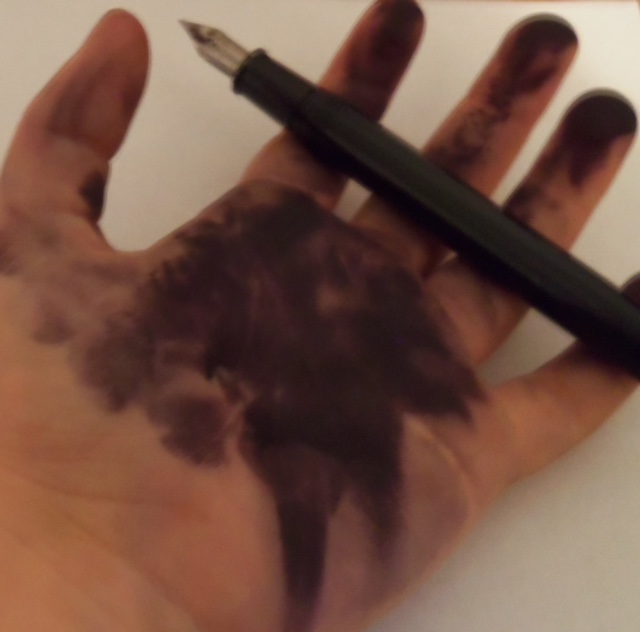
Most of the time, for us, we write because we don’t know how not to. We just can’t not write. Whether it’s sitting at the desktop or laptop, putting notes down in a phone, or using actual pen and paper by scribbling in one of our several thousand notebooks, or grabbing the first thing we can find (ripped open envelope, back of an already used post-it, margin of a magazine… back of our hands even)… inspiration and ideas strike constantly.

It happens all the time, and everywhere.

Out walking, sitting on a train, having a coffee, when the lights are out and just before falling asleep, watching TV, watching a movie. Being a writer means being on call to the beautiful muse, 24/7.

There are other reasons too: writing keeps us sane, helps us make sense of the world (and of ourselves)… but perhaps most importantly of all, we just love it.

We love it so much.

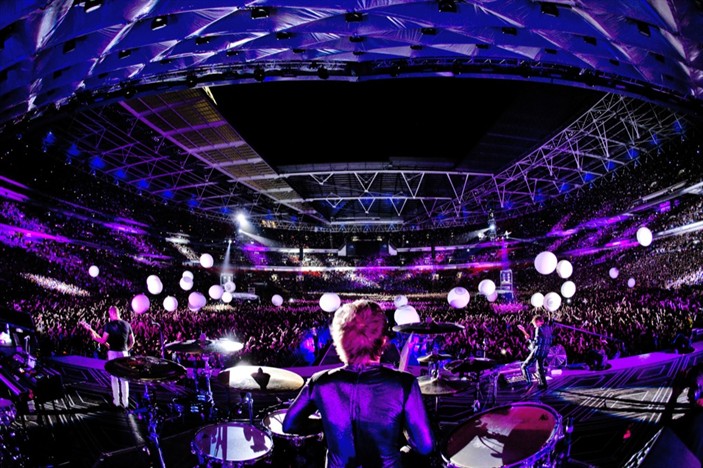
It’s an absolute blast, writing and being a writer. At its best, it feels like being in Pink Floyd or Muse and playing a guitar solo in a stadium full of screaming fans.

Just another Wednesday night, sitting on the sofa with the laptop

At least, it feels that way. Except, here’s the thing: when you’re a writer, there’s usually no one else there. That stadium is empty, most of the time. The truth is, being a writer is very much a “loneliness of the long distance runner” kind of activity. You’re running through an unforgiving landscape with no idea where the end of the race is going to be. But if you want to get there, you have to just keep running.

…or just keep swimming.

There’s really only one way to sustain that kind of existence: you have to love the crap out of it.

And we so do.

One of the most thrilling things in the world for anyone is possibility; but for a writer, the absolute most thrilling thing needs to be making possibilities become real, tangible, actual. You’re architect and craftsman, designer and builder. Yes, you have to be made of steel sometimes; you have to have an absolutely endless appetite for creating, for that thrill of coming up with something new… and for putting in the hours, weeks, months and maybe years to see it through.

And then, maybe, to spend that much time again getting rejected.

What?! Yeah, ‘fraid so.

So you have to really love it, because if you are in that phase of sending your work to others (agents, competitions, managers, other writers) and not hearing what you wanted to hear, you still need to be coming up with the next thing, and the next, and the next. Your desire needs to be immense, indestructible. Just like Celine says, your heart must go on (no, we can’t believe we went there either). You have to be utterly and hopelessly in love with this thing. Because it will hurt. It will be dark, sometimes. But you know, that’s okay, if you love it. That’s okay, if the sheer act of putting words on paper or on screen makes you feel like you’re Dave Grohl blasting out a Foo Fighters song at the Grammys.

Rocking out son

That absolute blast, that thrill of possibility and exploration is what drives us. The open road, the open sky… the open universe. We love launching ourselves into new worlds. It’s like being explorers, or mountain climbers. There’s a lot that goes into it, but the feeling when you discover that miraculous new world, or see that incredible view from the summit, is the most wonderful thing. We want it, over and over again. We’ll always want it.

Basically, being a writer is like having your own TARDIS.

This is what it’s like in our heads

You get to travel in time and space and see wonderful, mind-blowing things. Dreams that surprise you, scare you, change you. Every time you open a new Word doc (or Final Draft, or even just a blank piece of paper), it’s like the TARDIS has landed, and just like the Doctor, you have no idea what’s on the other side of that door. But you can’t wait to throw that door open and throw yourself into whatever adventure awaits.

Brilliant

Fantastic!

Olympic writing

Hello, and welcome to our obligatory Olympic-themed post about writing!

We’re loving the Olympics so far, and seeing all that excellence on display got us thinking about writing. Of course, there are a number of metaphors you could use here: the importance of sticking the landing, having a great anchor routine/fast finish, being driven by passion, staying hungry for the prize… And so many sports to choose from for analogies: the precision of archery, the endurance of the 10,000m, the relentlessness of swimming race after race.

But in the end, what really resonated for us was this: degree of difficulty vs. execution.

Yep, we’ve been watching a lot of gymnastics!

And that’s how gymnastic routines are scored. Each competitor has a maximum potential score based upon the difficulty of their routine, while their actual score depends on how flawlessly they execute it. And it struck us: this is exactly how writing works. Readers, consciously or subliminally, tend to respond to books based on brilliant ideas, brilliantly executed.

What does that mean for writers? True, this is an analytical approach: it’s the layer beneath the layer of how people react to books, and why they fall in love with some and not others. But generally speaking, the more thrilling the narrative (and the thrills can be conceptual, emotional, action-based or humor-related), and the more momentum it has, the more you feel engaged with it. You’re much more likely to keep turning those pages.

We all want novels to sweep us up, take us away, make us dream, lose us deep within their worlds.

That can only happen if the author has a high degree of difficulty in their routine, and carries it out flawlessly. Readers are of course judges, issuing deductions based on each error: typos, character inconsistencies, breaking the flow… they all add up, detracting from the overall experience. Too many, and it can all be over. If the author ends up on their butt, the readers will get up off of theirs and go find something else to do.

Degree of difficulty doesn’t just mean twisty plots, or groundbreaking narrative techniques — it can mean those things, but it can also mean creating deeply atmospheric alternate worlds, making us feel, breaking our hearts, changing the way we see the world, and ourselves. Those things are not easy. But when an author makes them happen, we don’t even see them at work — we just get utterly drawn in, hypnotized, “book-whispered.”

YA authors Patrick Ness and Laini Taylor are the reigning champions. They’re at the top of the podium. The degrees of difficulty of their novels are immense: Ness has to take us to another world and make us experience hearing a multitude of other people’s and creatures’ thoughts, while Taylor has to create new magic and make us fall in love with angels while we feel terror and rage and desire in our blood.

Their execution is utterly flawless. Ness’s brilliance in conveying exactly what it feels like to hear the ‘noise’, while also feeling all of Todd’s extreme emotions, is just staggering. He uses the page in extraordinary ways, and creates something entirely, thrillingly new that is also deeply grounded in overwhelming heart and soul. Taylor is bewitching with her richly mystical narrative scorcery. She fills your head and your dreams with magic and desire. It’s spooky, and wonderful.

The behavior of our hearts is a complex and beautiful thing. When writers impact us on this level, it can change our lives. Just like watching someone win an Olympic gold can be deeply inspiring, and can let us know that dreams can be achieved — with dedication and passion.

What does this mean for writers? You have to constantly practice your craft, hone it, obsess over it like those athletes who get up at 4am and train all day, every day, every week, every month, every year. You have to inhabit your writing. Utterly. You have to keep reading, revising… and writing. Always be writing. It takes an extraordinarily high level of obsession to do this.

So while the Olympians keep winning their medals, as writers we take heart and inspiration. Dreams are wonderful things, but they’re made from sweat and tears, from giving yourself entirely to winning that gold.