How do you know when you’re watching something written by TV writer, showrunner extraordinaire and all-round genius Russell T. Davies? You’re probably crying.

Russell T. Davies
And by the way, those tears probably started in laughter. Which happened in the middle of a thrilling action sequence in which the characters you LOVE are thrown into high stakes peril, and have to use extreme cleverness to save themselves from a situation that somehow blends terrifying concepts with overwhelming heart, soul and emotion.
That’s just an average scene for Davies, because he is the master of the human heart. When he REALLY wants to mess with you, it’s just devastating.
Davies is best known for his tremendous resurrection of the longest running sci-fi show in TV history, DOCTOR WHO (it first aired in 1953!). This tale of a time-traveling Time Lord known only as The Doctor who journeyed through the universe in a TARDIS (a time machine in the form of a blue police box), usually in the company of one or two humans who were looking for adventure, was originally a much-beloved, yet quaint, show on the BBC. It was known for its charm, inventiveness, futuristic electronic scores and less-than-stellar special effects. Sadly, over time, ever more ridiculous storylines resulted in the show being axed in the eighties, seemingly never to return (with a brief exception in the form of a TV movie that popped up in 1996).
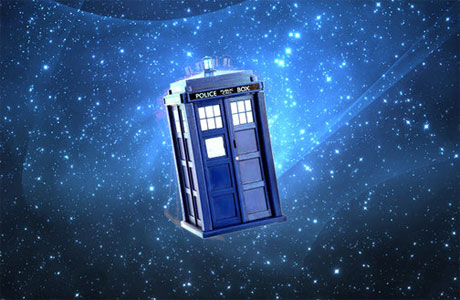
The TARDIS. There’s a reason why it looks like that.
However, Davies, who, despite his roots in the gritty, everyday dramas of everyday people, was a huge sci-fi fan, and a fan of the show, rescued it from its cancellation wasteland in 2005 and rebooted it into a glossy global phenomenon.
How did he do it?
With brilliant writing. With feelings. With, as the ultra-smart and Scottish late night talk show host Craig Ferguson describes it, a healthy dose of “intellect and romance.” Because no one does feelings quite like Davies. His stories and scripts are overflowing with heart and emotion. And they’re extraordinarily clever too. But it’s not the cleverness that keeps us there: it’s the people. Davies’ background in writing astonishingly great dramas about “everyday” people was key to the success of this most fantastical of shows. Davies knows how to give us the shortcut right into a character’s soul, and make us feel what they feel. Although the show is called DOCTOR WHO — and although Davies did reimagine the Doctor as intelligent, bold, and very funny, as well as being a dangerous and charismatic hero-figure — he was the first to truly realize that the heart of the show (one of them at least) should be the human companions that accompanied this alien Time Lord. Because they were our stand-ins. Our view into the conceptually mind-bending experience of actually traveling through time.

The Doctor (on the left) and something REALLY SCARY on the other side of the wall
Davies was rebooting a sci-fi show and making it fresh and “now.” He could have focused on spaceships, spectacle, action. Instead, to begin this new journey, he crafted a beautiful hour of television that showed us how a girl with dreams plucks up the courage to try and chase them. And so his first episode, the one that relaunched the show, was simply titled Rose, after the girl who decides to give up her life on Earth to follow the Doctor into the stars.

Rose Tyler, played so perfectly by Billie Piper
Rose Tyler is an ordinary, working class girl, living a regular life, living with her mother in a tiny flat, working in the local department store, just trying to get by. But she dreams of so much more than that. When she gets chased by mannequins possessed by an evil alien lifeforce, has to deal with her store blowing up, and, in one brilliant scene, fails to notice that her boyfriend’s monosyllabic responses are not due to his disinterest but the fact that he is a replica created by the aliens, Rose realizes that life doesn’t have to be ordinary, or even safe. She chooses the thrill of the unknown, and accepts the Doctor’s offer (once he’s saved the day), to journey with him. The smile on Rose’s face as she runs into the TARDIS is one of the emotional high points of the entire show.
Davies understands what it is to dream of something more than what you have, and how you can become something extraordinary when you’re in the most challenging of situations. His characters, his writing, resonate so powerfully. As writers often like to say on Twitter, his writing has ALL THE FEELS.
His era of Doctor Who ran from 2005 through 2009, and it was extraordinary. It’s up there with the best of TV sci-fi like BUFFY, FIREFLY, STAR TREK, BSG, FRINGE, and Davies’ own WHO spin-off, TORCHWOOD. Davies wrote a book about running DOCTOR WHO, called The Writer’s Tale. If you are writer of any kind, a storyteller of any sort, a fan of the show, a fan of sci-fi, a fan of TV, an aspiring showrunner, or just interested in how stories are told, you need to read this book. It’s one of the greatest books about writing, about stories, about TV, ever written. You can see the detailed evolution of stories from initial idea to treatment to draft to shooting script. It’s fascinating, and it shows you above all how important character is.
It doesn’t hurt that Davies is a genius sci-fi writer, able to spin incredible ideas together and create deep and detailed worlds, often one after another to fulfill the hungry demands of a long-running episodic TV show. And he subtly layers in long-running arcs that build to insane crescendos like a boss.
But whatever he is writing, however fantastical the setting, Davies’ primary concern is always the character, and how to make us feel.
And boy, does he make us feel.



 A.D. Croucher